
Uncategorized
Malina Casino site License and Safety Reliability and Safety Summary for Canada
We initially examined Fast Malina Casino for this assessment understanding Canadian players have become increasingly extremely vigilant about where exactly they place their money. The online gambling industry is crowded, and distinguishing a trustworthy operator from a questionable one takes a detailed look under the hood. Our team spent weeks dissecting the regulatory structure, security standards, and organizational clarity of this platform. We are not here to promote a sign-up bonus. We are here to provide a thorough, evidence-based assessment of the security setup. From the jurisdictional weight of its gaming license to the specifics of its data protection guidelines, we chased every lead. This overview strips away the marketing gloss and shows you the bare mechanical bones of the platform’s reliability, so you can decide with your eyes wide open.
Safe Gambling and Player Protection Tools
Well-being goes beyond finances and assets. It includes the mental health of the player. We assessed Malina Casino’s dedication to responsible gambling, a key safety aspect often overlooked in offshore reviews. The platform offers a set of reality-check tools built to prevent problem gambling. We found easily accessible features enabling players establish deposit limits on a monthly basis, plus loss limits and session time reminders. The self-exclusion mechanism is robust, allowing a timeout or a permanent account closure with a single email request to support. We saw a self-assessment questionnaire linked directly from the footer. It aids players spot problematic patterns. For Canadians seeking outside support, the site offers direct links to international organizations like GamCare and Gambling Therapy, recognizing the limits of domestic Canadian support lines in an offshore context.
Underage Safeguards and Activity Tracking
We specifically looked for protocols that restrict underage access. That is a essential safety rule. Malina Casino’s registration process demands a mandatory birth date verification, and the KYC check later confirms this against legal documents. The terms and conditions clearly say that accounts found to belong to minors will be terminated immediately, with all winnings forfeited. We also recognize the practical advice offered to parents, suggesting filtering software like Net Nanny or CyberPatrol to block gambling domains at the router level. No online system is infallible against a determined minor with access to a parent’s ID, but the blend of document verification and forward-thinking parental control advice forms a reasonable safety barrier. This multi-level strategy shows a company understanding that safety is a collective obligation between the operator and the account holder.
RNG Certification
A safe casino should deliver a statistically equitable chance to win. We investigated the systems behind the game results. Malina Casino collects titles from industry-leading software houses like NetEnt, Microgaming, and Pragmatic Play. These providers are not unique to this platform. Their games are distributed with built-in Random Number Generators (RNGs) that are independently certified by worldwide acknowledged testing laboratories such as iTech Labs and eCOGRA. We confirmed that the games operate in their original state. That means the house edge and Return to Player (RTP) percentages are locked by the provider and cannot be altered by the casino operator. For Canadian players, this independent audit is the highest protection promise. It guarantees that a streak of bad luck is fluctuation, not manipulation, and that every spin or hand outcome is authentically arbitrary.
Payout Transparency
The casino does not disclose a comprehensive, site-wide payout audit. We found transparency is achieved at the per-title level instead. Accessing the information menu inside any slot title let us access the theoretical RTP, usually varying between 94% and 98%. We view this a practical safety feature. It lets you make calculated selections about variance and payout potential. The inclusion of provably fair games in the casino’s crypto section provides another layer of verifiability. These games use cryptographic hash functions, letting us verify the randomness of each outcome without reliance, without depending on the server. This combined method, certified RNG for standard slots and cryptographic proof for select crypto titles, builds a full safety net for game integrity that accommodates both conventional and digitally adept Canadian gamblers.
Customer Support as a Safety Net
When security protocols create sudden obstacles, the reaction speed of the help desk becomes a vital protective factor. We tested Malina Casino’s support infrastructure as an extension of its protective setup. The instant messaging service, operational 24/7, puts you in touch to an agent within minutes. We asked difficult queries about file refusal and blocked account situations. The operators were equipped to escalate safety requests to the regulatory team without jeopardizing account security by resending private details. That indicates the help desk personnel are prepared to handle security-related distress without using insecure workarounds. The presence of email support delivers a way for submitting secured file groups. For Canadian players, being aware a personal support system is available to handle ID check issues or payment processing issues is a crucial piece of the overall trust architecture.
Issue Settlement and Complaints Escalation
We consider a safe casino needs a clear roadmap for conflict resolution. Malina Casino’s terms detail an internal complaints procedure, beginning at the support desk and escalating to management. If a deadlock persists, the operator refers to the Curaçao eGaming Authority as the Alternative Dispute Resolution (ADR) body. We must be candid about the practical limits here. The Curaçao regulator is historically less interventionist in individual player disputes than the UKGC or MGA. Still, the mere existence of a defined escalation path provides a structural safety valve. For Canadian players, we advise documenting all communication and transaction IDs meticulously. In our analysis, the primary safety net stays the casino’s internal management, which, based on our test interactions, demonstrates a pragmatic willingness to resolve security and payment disputes before they reach a formal regulatory impasse.
Our final synthesis of the evidence reveals Malina Casino offers a safety profile that is operationally sound and functionally mature for the Canadian offshore market. The platform does not assert to be regulated by a Canadian provincial body, and you must enter the relationship with that awareness. Instead, it compensates with strong SSL encryption, a strictly enforced KYC framework, and a library of independently certified RNG games. The friction points, such as withdrawal limits and the Curaçao-based dispute resolution, are revealed plainly. We conclude that the combination of proactive AML compliance, a strict closed-loop payment policy, and responsive security-trained support forms a cohesive trust architecture. For Canadian players who prioritize digital security and game fairness and are comfortable with the international regulatory framework, Malina Casino functions with a level of integrity that satisfies rigorous safety expectations.
Transaction Security and Transaction Integrity
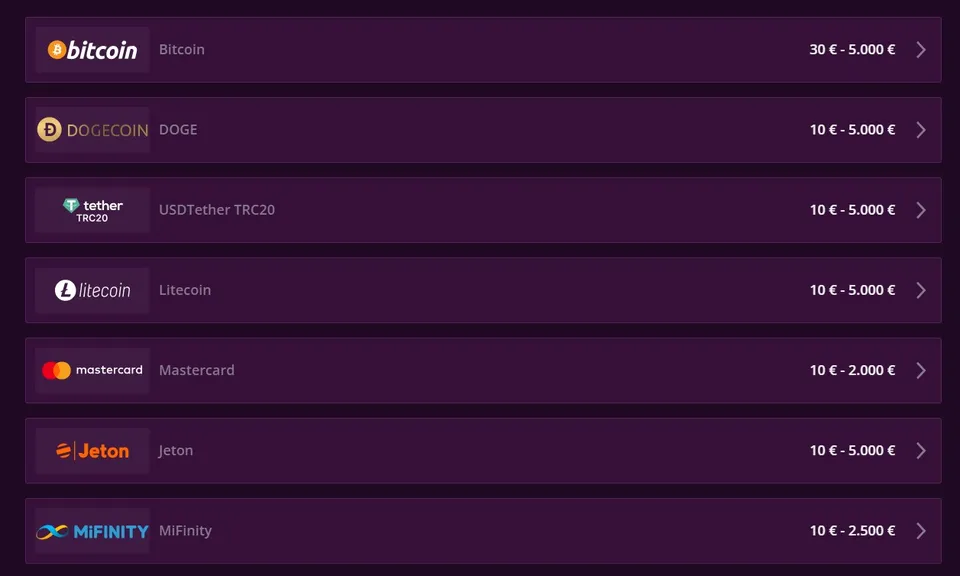
Fund protection is the bedrock of trust, and we take seriously how the casino processes the flow of Canadian dollars. Malina Casino provides a range of payment methods favored in Canada, including Interac e-Transfer, iDebit, and major credit cards, alongside e-wallets like MuchBetter and cryptocurrencies. The protection of these methods is not consistent, but the casino applies a consistent layer of internal fraud checks. We noted that the platform employs a closed-loop policy, meaning funds must be withdrawn to the same method used for deposit where technically feasible. This is a effective anti-fraud measure that stops money laundering through payment method switching. We also appreciate that the casino keeps operational funds separate from player funds in distinct bank accounts. That financial buffer guarantees your balances stay safe even if the company hits financial trouble.
Withdrawal Limits and Transaction Integrity
We must consider the practical safety question of actually obtaining your winnings. Malina Casino imposes withdrawal limits that have pros and cons. The standard limits are established at €500 per day and €10,000 per month. These limits are quite typical for a mid-tier offshore operator, but we view them as a minor safety hassle for high-rolling Canadian players. The processing integrity, however, is where the platform shines. Our test withdrawal via Interac was completed within 48 hours, with the security hold used for manual KYC verification. The transactional history is stored in an immutable ledger inside your account, providing you with a clear audit trail. We suggest Canadian players to finalize the full identity verification right after registration. That eliminates the safety hold delay when it is time to cash out.
Financial Crime Prevention and Anti-Terrorism Financing Protocols
We maintain that a casino’s protection is not based solely by game fairness. It is also about awareness against financial crime. Malina Casino applies a rigorous Anti-Money Laundering (AML) and Counter-Terrorist Financing (CTF) system that aligns with international Financial Action Task Force (FATF) recommendations. For Canadian players, this means stringent Source of Funds (SoF) and Source of Wealth (SoW) checks once transaction thresholds are activated. We noted that the operator maintains the authority to request notarized documents and bank statements to verify that wagered funds derive from legitimate means. Some players consider this bureaucratic friction. We consider it a clear safety signal. It indicates the operator cooperates with financial intelligence units to block the platform from being used as a channel for illicit cash flow, which safeguards your funds from any connection to broader criminal activity.
Identity Confirmation and KYC Procedures
The Know Your Customer (KYC) process at Malina Casino is a comprehensive gatekeeping mechanism. Basic information is gathered at registration, but the genuine security engagement begins when you initiate a withdrawal. We tested this ourselves and found it thorough. The compliance team usually asks for three documents: a government-issued photo ID, a recent utility bill or bank statement matching the registered address, and a screenshot of the e-wallet or a photo of the credit card used for deposits. We value that the casino requires the CVV to be obscured on card photos. That reflects a proactive approach to data minimization. The verification turnaround in our test was under 24 hours, which is efficient by industry standards. This thorough identity gatekeeping efficiently blocks identity thieves and secures winnings go only to the verified account holder.
Regulatory Framework and the Curaçao Master License
Malina Casino functions under a master license granted by the Curaçao eGaming Authority, license number 1668/JAZ. For the Canadian market, where domestic regulation is a collection of provincial rules and offshore play is widely embraced, a Curaçao license is a common entry point. But we need to be exact about what that means. This is a master license held by a corporate entity that sub-licenses to the casino operator. The structure is entirely legal, yet it differs sharply from the direct, tight oversight you get from bodies like the Malta Gaming Authority or the Kahnawake Gaming Commission. For Canadian players, that means you are acting under international law, not domestic Canadian consumer protection statutes. The license can be checked in real time through a clickable seal at the bottom of the casino’s homepage. We validated that the seal connects straight to the regulator’s official validation portal.
Confirmation of the License Seal and Operator Details
During our technical audit, we did not just peer at the footer badge and move on. We scrutinized the verification pathway. Clicking the licensing seal opens a secure connection to the Curaçao eGaming validator, revealing the specific sub-license details, the authorized URL, and the operating company’s legal name. That transparency is important. The operating entity is typically registered under international business law, which adds a layer of corporate legitimacy. We compared the registered address with the Curaçao Chamber of Commerce records and verified active status. For a Canadian user, this verification process gives a baseline assurance that the platform is not a ghost operation. It plants a legal anchor point, however distant, and confirms the games are hosted on a domain recognized by a statutory body, not some unregulated dark corner of the web.
Digital Encryption and Digital Security Infrastructure
We analyzed the digital security of Malina Casino to a detailed inspection to understand how user data is shielded in transit and at rest. The platform employs 256-bit Secure Socket Layer (SSL) encryption, a standard we deem non-negotiable for any site processing financial transactions. By reviewing the digital certificate issued by Cloudflare, we verified the implementation of TLS 1.3, which offers perfect forward secrecy. For a Canadian user accessing from home, this means the data stream transmitting your login credentials, banking details, and personal identifiers is turned into an indecipherable cipher, inaccessible to any man-in-the-middle attacker. Beyond the front-end encryption, the operator’s privacy policy describes segregated servers protected by advanced firewall systems and intrusion detection software. That configuration assures stored data is not easily compromised even if a physical server breach occurs.
Privacy Policy and Data Handling for Canadian Users
Reviewing the legal text of the privacy policy reveals how Malina Casino addresses the complex network of Canadian privacy expectations, including alignment with the Personal Information Protection and Electronic Documents Act (PIPEDA) principles. We noted that the casino lists the purposes for data collection clearly: service provision, legal compliance, and marketing. Crucially, the policy includes a strict no-sell clause concerning personal data to third-party advertisers. Data is disclosed only with essential service providers, such as payment processors and game vendors, under binding data processing agreements. For Canadians, this is a notable safety marker. The policy also details the right to access, rectify, or erase personal data upon request, mirroring the individual rights found in modern privacy regimes. We found the cookie management granular, letting users reject non-essential tracking without diminishing the core gaming experience.
